Navigating the Warehouse Automation: AGVs vs. AMRs Explained
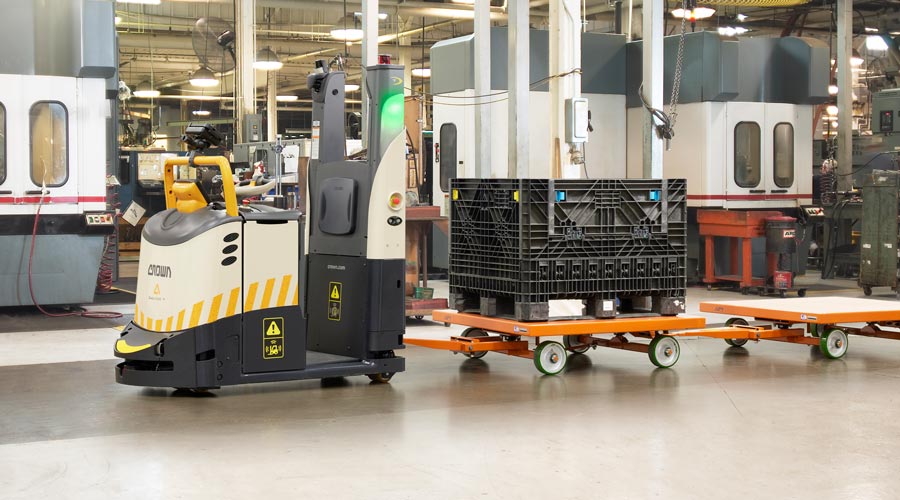
Two terms often come up when warehouses evaluate automation solutions: automated guided vehicles (AGVs) and autonomous mobile robots (AMRs).
Both technologies can support warehouse automation, but they differ in how they navigate a facility and execute material handling tasks. Understanding those differences can help you determine where each may fit within your operation.
How Do AGVs and AMRs Navigate?
Automated lift trucks can use either AGV or AMR navigation and traffic management:
- AGV navigation has been in use longer and typically directs the vehicle along a fixed path. When an object blocks that path, the vehicle stops and waits until the route is clear.
- AMR navigation allows the vehicle to maneuver around obstacles and is often used on smaller vehicles operating at low travel speeds.
Look Beyond the Navigation System
The terms AGV and AMR are sometimes used as though they describe one specific type of vehicle. In practice, the navigation system and the vehicle’s material handling capabilities are separate considerations.
Flatbed AMRs can also transport pallets horizontally but have limited vertical capabilities. They often rely on supporting infrastructure at pickup and drop-off locations to collect or deposit pallets.
An automated lift truck can place a pallet directly on the floor and retrieve one from a rack at height. When paired with AGV navigation, it combines fixed-path travel with the pallet-handling capabilities expected from a lift truck. Automated lift trucks and flatbed AMRs may also work together within the same material-handling process.
Prepare the Process for Automation
The idea that an operation can “just remove the person and have the lift truck run by itself” doesn’t reflect how automation works in practice. Existing processes often need to change before an automated truck can perform the work reliably.
Automation requires consistent processes. Pallets must be routinely built in acceptable condition, barcodes must remain readable and pickup locations and travel routes must be predictable. Addressing these issues can help reduce exceptions while improving both manual and automated operations. Teams can then continue refining the process as they gain experience with the system.
Keep Employees Involved
Automated vehicles still depend on employees who understand the equipment, workflow and warehouse management system.
A team of AGV tenders may be able to support a larger fleet of automated vehicles. These employees may be your current lift truck operators who can intervene when a vehicle encounters an exception. In these cases, lift truck capable of both automated and manual operation, such as Crown’s DualMode automated forklifts, can be quickly repositioned by the tender/operator and automated operation can continue.
Automation can also provide employees with the opportunity to support exception handling, inventory accuracy, quality control or other work elsewhere in the operation.
Match the Technology to the Application
Automated lift trucks have become faster and more reliable in recent years as sensors and traffic management systems have improved. Even so, selecting the right approach requires looking beyond general performance to the specific demands of the operation.
Consider the complete application: the load, travel path, pickup and drop-off requirements, vertical movement and surrounding processes. AGV navigation offers fixed-path travel and can be used with automated lift trucks capable of handling pallets at floor level and at height. AMR navigation provides a different approach for vehicles operating at floor level that need to maneuver around obstacles.
Start with the work that needs to be done, then select the vehicle and navigation approach that can execute the process reliably. Often the solution requires a combination of AGVs and AMRs assigned to specific tasks where they can do what they do best.