Forklift Batteries: A Quick Reference
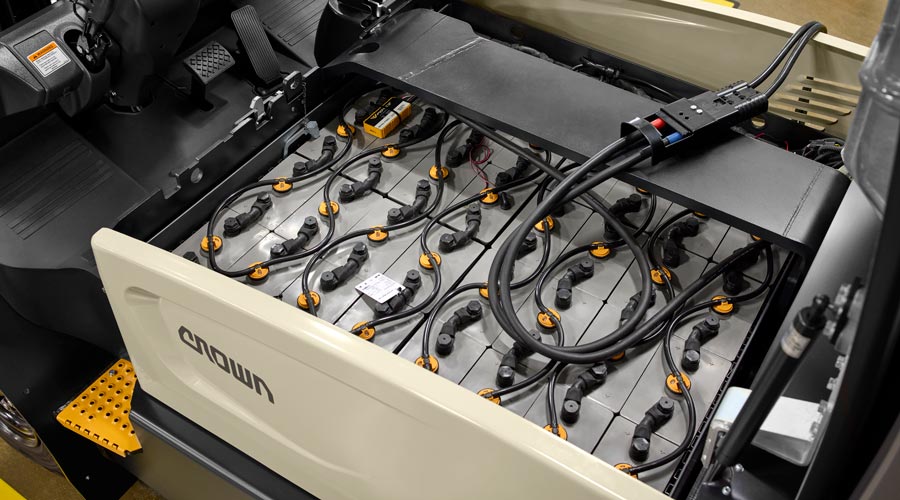
Choosing the right power source for your forklift fleet can help deliver greater efficiency, more uptime for your business and a competitive edge. The other important aspect of this decision is understanding your power options. Here’s a brief overview of available forklift battery technologies and their benefits.
V-Force Lead-Acid
Lead-acid batteries have long been the standard choice for many forklift applications because of their accessibility, relative cost-effectiveness and rugged capabilities.
Benefits:
- Typically lower initial cost
- Capable of withstanding shock and vibration due to its sturdy and robust design
- Nearly 100% recyclable and the process is relatively simple and cost-effective
Challenges:
- Longer recharge times (typically eight to 10 hours, excluding cool-down), requiring multishift operations to store spare batteries
- Typical lifespan of 1,000 to 1,500 charging cycles when properly maintained
- Routine maintenance, including regular watering and cleaning is necessary to avoid premature battery failure
- Potential exposure to gassing or acid during charging or maintenance
V-Force Lithium-Ion
Though not a new technology, recent innovations and increased accessibility make lithium-ion batteries a viable option for certain lift truck fleet applications, though their benefits require a larger battery investment.
Benefits:
- Increased energy efficiency and runtime with typical recharging using up to 16% less energy than lead-acid
- Decreased maintenance, storage and safety concerns
- Typically charge faster, about one hour for eight hours of use, with no cool-down time, allowing “opportunity charging” during operator breaks throughout a shift
- No need to maintain extra batteries for multishift operations
- Life span of up to 9,000 charging cycles with proper maintenance
Challenges:
- Greater up-front cost
- Lithium-ion recycling is a developing, complex process
- Lithium-ion batteries must be supplemented with additional counterweight to ensure certain performance specifications are maintained
- Applications and facilities designed for lead-acid battery use may require changes to charging processes and locations to achieve efficiency goals
- Operators will require training regarding charging methods and expectations
Fuel Cell Technology
Fuel cell-powered forklifts have existed for the last decade but have only seen limited large-scale adoption. They generate electricity through a chemical reaction between oxygen and a fuel source, typically hydrogen or natural gas.
Benefits:
- Zero CO2 emissions during operation
- Extremely fast refueling, usually in just minutes
- Comparable energy density to lithium-ion batteries
Challenges:
- Much greater up-front costs than battery-powered forklifts
- Requires a ready supply of fuel (like hydrogen gas) for refueling, whether delivered or produced on site, requiring a significant capital investment
- Additional measures to monitor fuel leakage are required
Forklifts are a significant investment. Part of protecting that investment includes choosing the right battery technology and size for each forklift and the overall application. The right power solution will ensure the forklift operates at peak performance and efficiency. As batteries continue to evolve, an integrated forklift solutions provider can help you right-size your forklift batteries to meet your operational goals.
To learn more about developing an integrated energy strategy for your forklift fleet, read Crown’s new e-book “A Winning Power Play: Developing an Integrated Forklift Energy Solution.”
The e-book is designed to help fleet managers evaluate current practices and identify solutions tailored to fleet, site and application requirements. It examines the considerations that factor into power decisions, describes a method for gaining visibility into power usage, and explains the characteristics of different battery technologies and charging strategies.
Finally, the e-book outlines how to bring all of that together into a more cohesive, end-to-end strategy that can be further enhanced by working with suppliers who can provide an integrated forklift energy solution.